
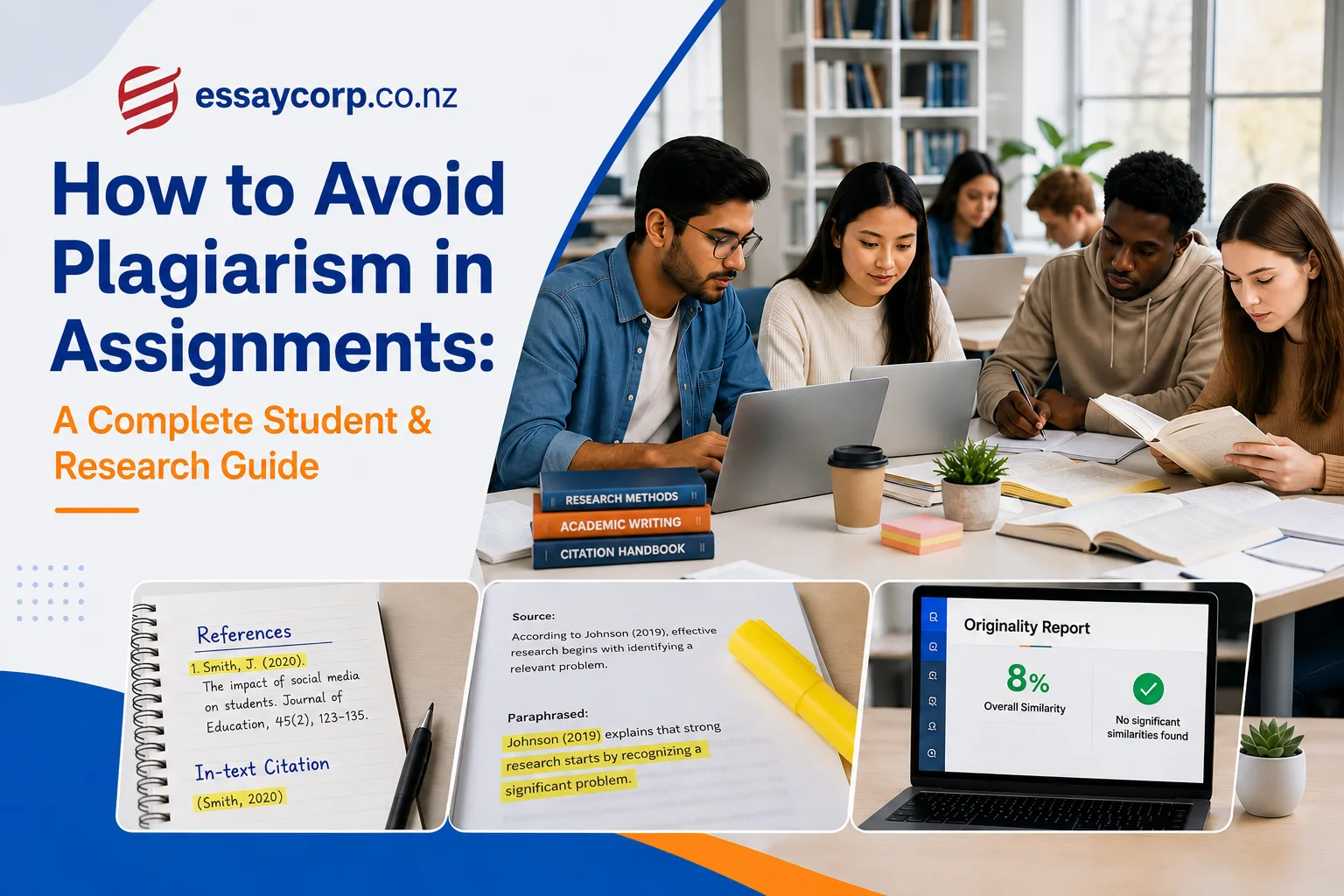
Submitting original work is one of the most critical responsibilities every student carries throughout their academic journey. Whether you are working on a management assignment, a thesis assignment, or a nursing assignment, plagiarism can lead to serious consequences including failing grades, suspension, or permanent academic record damage. Students seeking assignment help in NZ often ask how to write confidently and ethically — and the answer lies in mastering the right techniques. This guide will walk you through everything you need to know to produce plagiarism-free assignments every single time.
What Is Plagiarism and Why Does It Matter?
Plagiarism is the act of using someone else's ideas, words, data, or research without giving them proper credit. It does not always happen intentionally — many students plagiarise without even realising it.
Academic institutions treat plagiarism as a serious ethical violation. Understanding what counts as plagiarism is the first step toward avoiding it.
Types of Plagiarism You Must Know
- Direct Plagiarism – Copying text word-for-word without quotation marks or citation
- Self-Plagiarism – Resubmitting your own previous work without permission
- Mosaic Plagiarism – Mixing original content with copied phrases without attribution
- Accidental Plagiarism – Forgetting to cite a source or incorrectly paraphrasing
- Global Plagiarism – Submitting someone else's entire work as your own
Whether you are writing a case study, a dissertation assignment, or a science assignment, all forms of plagiarism carry equal academic risk.
Academic Writing Tips to Stay Original
Producing original content does not mean you cannot reference external sources. It means you engage critically with those sources and present ideas in your own voice.
Build a Research-First Habit
Before writing a single word, invest time in researching your topic thoroughly. Use credible sources such as peer-reviewed journals, government publications, and academic databases. Students working on a medical assignment, genetic assignment, or clinical reasoning cycle assignment especially need to rely on authoritative, up-to-date sources.
Top Research Writing Tips
- Start your research at least 3–5 days before the deadline
- Take structured notes and always record the source immediately
- Distinguish between facts, opinions, and your own analysis
- Never copy-paste into your draft document — use a separate notes file
Paraphrasing Techniques That Actually Work
One of the most powerful academic writing tips is mastering the art of paraphrasing. Paraphrasing is not just swapping a few words with synonyms — it means genuinely restructuring and rewriting a concept in your own words.
How to Paraphrase Correctly
Step-by-step paraphrasing method:
- Read the original passage carefully until you fully understand it
- Put the source away and write the idea from memory
- Compare your version to the original to ensure it is substantially different
- Add the citation even though you paraphrased
Common Paraphrasing Mistakes to Avoid
- Changing only one or two words while keeping the sentence structure intact
- Forgetting to cite the source after paraphrasing
- Paraphrasing without understanding the meaning first
- Over-relying on paraphrasing as a replacement for original analysis
Students writing accounting assignments or marketing assignments often make the mistake of heavily paraphrasing textbook definitions. Instead, use those definitions as a foundation and add your own critical interpretation.
Citation and Referencing — The Right Way
Proper citation and referencing is what separates academic writing from plagiarism. Every time you use an idea, statistic, quote, or argument that originated from another source, you must cite it.
Common Referencing Styles
|
Style |
Commonly Used In |
|
APA 7th Edition |
Psychology, Education, Social Sciences |
|
Harvard |
Business, Law, Humanities |
|
MLA |
Literature, Arts, Humanities |
|
Chicago |
History, Fine Arts, Social Sciences |
|
Vancouver |
Medical and Health Sciences |
Students completing aged care nursing assignments, childcare assignments, or nursing assignments typically use APA or Vancouver style. Always check with your institution which style is required.
How to Cite Sources — Quick Reference
In-Text Citation Tips
- Always include the author's last name and year of publication
- For direct quotes, include the page number as well
- Use "et al." when there are three or more authors (APA style)
- Ensure every in-text citation matches a full entry in your reference list
Reference List Essentials
- List references alphabetically by author's last name
- Include all publication details: author, year, title, publisher, DOI/URL
- Format consistently — one style error can cost you marks
- Use reference management tools like Zotero, Mendeley, or EndNote
Best Plagiarism Checker Tools for Students in 2025
Before submitting any assignment, running your work through a reliable plagiarism checker tool is a non-negotiable step.
Top Plagiarism Checker Tools
Free Tools
- Grammarly Free – Basic plagiarism check with grammar correction
- Duplichecker – Quick text comparison for shorter assignments
- PaperRater – Good for undergraduate-level checking
Premium Tools
- Turnitin – The industry-standard used by most universities worldwide
- Copyscape – Best for web-published content
- iThenticate – Preferred for dissertation assignments and thesis assignments
- Scribbr Plagiarism Checker – Excellent for detailed source comparison
How to Use Plagiarism Checkers Effectively
- Run your paper before the final proofreading stage so you still have time to fix issues
- A similarity score below 10–15% is generally considered acceptable
- High similarity from your own reference list is normal — checkers usually exclude bibliographies
- Review each flagged section individually rather than blindly rewriting everything
Practical Strategies to Avoid Plagiarism in Assignments
Now that you understand the tools and techniques, here are actionable strategies to embed into every writing task.
Build Original Arguments
The strongest plagiarism-free assignments are built around your own analytical thinking. Use sources as evidence to support your argument — not as a replacement for one.
- Form your thesis or central argument before researching
- Ask yourself: "What is MY position on this topic?"
- Use sources to back up your reasoning, not to substitute it
- Add critical evaluation — agree, disagree, or qualify what your sources say
Time Management Is an Anti-Plagiarism Tool
Students often plagiarise because they are desperate and running out of time. Planning your research writing guide schedule eliminates panic-driven shortcuts.
- Break your assignment into phases: research, outline, draft, revise, cite, submit
- Never leave citation for the last step — add references as you write
- Allocate one full session just for proofreading and plagiarism checking
Subject-Specific Tips
- Management assignment – Cite business theories and frameworks by the original theorist
- Marketing assignment – Always attribute market research data to its published source
- Accounting assignment – Reference accounting standards (IFRS, GAAP) with official documentation
- Science assignment – Cite experimental data and findings from peer-reviewed journals
- Genetic assignment – Reference databases like NCBI or published genome studies
- Medical assignment – Use up-to-date clinical guidelines and cite edition/year
- Childcare assignment – Reference early childhood education frameworks and policy documents
- Clinical reasoning cycle assignment – Cite nursing models and clinical decision-making frameworks
- Aged care nursing assignment – Reference aged care standards with accreditation body details
Building a Long-Term Academic Integrity Habit
Avoiding plagiarism is not just about passing a plagiarism check — it is about developing genuine intellectual integrity that serves you throughout your career.
Develop Your Own Academic Voice
Reading widely helps you develop an authentic writing voice. The more you read academic papers in your field, the more naturally you will begin to express complex ideas in original ways.
- Read at least two to three academic articles per topic before writing
- Annotate and summarise sources in your own words immediately after reading
- Practice freewriting — write your ideas without looking at your notes first
Conclusion
Avoiding plagiarism is entirely achievable when you commit to proper research habits, honest paraphrasing, accurate citation and referencing, and consistent use of plagiarism checker tools. Whether you are submitting a straightforward marketing assignment or a complex thesis assignment, the strategies in this guide give you everything you need to write with confidence and integrity. Original thinking backed by credible sources is what truly impresses academic reviewers — and it starts with the choices you make before you write your first sentence. Make integrity your default setting, and your academic journey will be built on a foundation that lasts.