
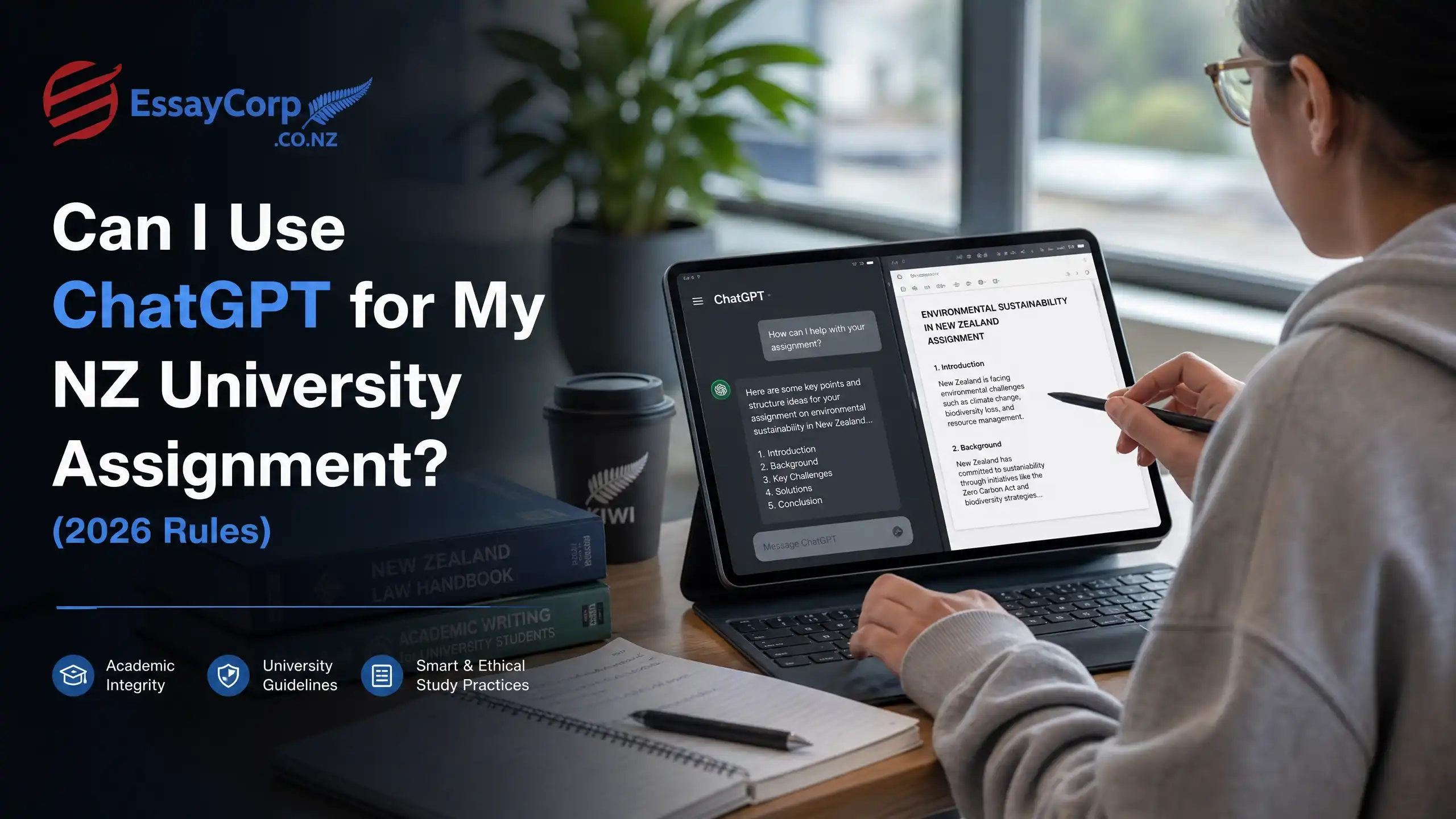
Quick Answer: It depends on your course, not your university as a whole. There is no single New Zealand-wide rule that bans or allows ChatGPT. Instead, most universities — including Auckland, Victoria University of Wellington, and Waikato — now leave the decision to individual course coordinators, who must tell you which "lane" or category an assessment falls into. If you're not told otherwise, treat AI tools as not permitted unless the assignment explicitly says you can use them, and always disclose any AI use you do make. Using undisclosed AI on a piece of work you're meant to complete independently can count as academic misconduct, even if the writing itself is good.
If that sounds vague, that's because it is — deliberately so. AI policy in NZ tertiary education isn't settled around one national standard the way, say, referencing style is. Here's what's actually going on in 2026, and how to stay on the right side of it.
If you've been searching things like "is using ChatGPT for assignments cheating in NZ", "ChatGPT rules for university assignments New Zealand", or "AI assignment help NZ university students", you're not alone — this has become one of the most-asked questions on Kiwi campuses heading into the 2026 academic year.
There's No Single "NZ Rule" — It's Set at Course Level
A lot of students search for one clean answer, but New Zealand's approach to AI in higher education has landed on context-based permission rather than a blanket policy. The New Zealand Qualifications Authority (NZQA) sets the tone for schools and NCEA, where the rule is much simpler: generative AI is not permitted for NCEA external assessments. But universities operate independently of NZQA, and each has built its own framework.
The clearest example is the University of Auckland, which is rolling out a two-tier system for how assessments treat AI:
- From 2027, all courses will explicitly label assessments as either "Lane 1" or "Lane 2," and many courses will start using these terms already in 2026.
- Lane 1 assessments are typically ones where AI use is restricted or banned (think closed-book exams or tasks assessing your own foundational skills).
- Lane 2 assessments are ones where AI use is expected or explicitly allowed, often with a requirement to show your process.
Auckland also requires all new students to complete an online academic integrity course, which includes a specific module on artificial intelligence.
Other universities frame it differently but land in a similar place. At the University of Waikato, uploading coursework to non-institutional generative AI platforms is flagged as carrying real privacy and ethical risks, and the university has been proactive about detection: since 2025, Waikato has used Turnitin's functionality to identify AI-generated work. Victoria University of Wellington (Te Herenga Waka) takes a similarly permissive-but-conditional stance, warning students that using AI when it isn't permitted on a piece of work can breach academic integrity standards, which counts as academic misconduct with serious consequences for both study and career. Wellington also reminds students that generative AI tools can "hallucinate," producing information that sounds believable but isn't accurate — a practical reason to double-check anything an AI tool gives you, quite apart from the integrity question.
Why Universities Won't Just Say "Yes" or "No"
It's tempting to want a straight yes/no answer, but a blanket rule doesn't really work for universities, and here's why:
- Different assessments test different things. A first-year essay meant to build your own analytical writing skills is a very different context to a final-year capstone project where using AI as a research assistant might be entirely expected — even encouraged.
- Detection tools are evolving, not finished. Waikato's use of Turnitin's AI detection functionality shows universities are actively building infrastructure to catch undisclosed use, but detection isn't perfect, and policy is catching up to the technology in real time.
- Professional and legal consequences matter. Some faculties have unusually strict rules because AI use ties directly into professional standards later on. Auckland's Law School, for instance, treats undisclosed AI use as something with career-long consequences: confirmed breaches of academic integrity go on the University's Register of Academic Misconduct, and any records on that register are declared to the Law Society for anyone applying to become a barrister and solicitor. The same guidance bluntly warns students that over-reliance on AI now will limit their career progression, since partners and supervisors can tell when junior lawyers lack foundational skills.
The One Rule That's Consistent Everywhere: Disclosure
Whatever your specific course policy is, the one principle that shows up across every university's guidance is disclosure. If AI use is permitted, you're expected to say so — clearly and specifically.
Auckland's Law School guidance gives a useful template for what disclosure should look like in practice, describing not just that you used a tool but what portions of your work came from AI versus your own analysis — for example, stating which model you used and what you asked it to do, then being explicit about how much of the final work was your own thinking versus AI output. Failing to disclose AI use that was otherwise permitted can itself constitute academic misconduct under the Student Academic Conduct Statute — so the AI use might have been fine, but hiding it isn't.
Importantly, this disclosure expectation applies broadly. Auckland's guidance is explicit that the prohibition on undisclosed use applies to all generative AI systems, including but not limited to ChatGPT, Claude, Gemini, DeepSeek, Microsoft Copilot, and xAI's tools — so switching tools doesn't get you around a course's restrictions.
A Practical Way to Think About It
Universities increasingly frame AI less like a calculator and more like a collaborator. Auckland's Law School guidance puts it well: AI is technically a tool, but it isn't like a calculator or spell-checker, because it performs intellectual tasks that you're actually being assessed on, and the learning process depends on genuine independent thinking. The better mental model is to ask yourself: "Would it be appropriate to ask a classmate or tutor to do this part for me?" If the answer is no, it's probably not appropriate to have AI do it either — regardless of whether your specific course has spelled that out in black and white.
There's also a New Zealand-specific wrinkle worth knowing: several university and Ministry of Education resources flag that AI models are likely to be weak on m?tauranga M?ori and te reo M?ori, as well as Pacific languages and Polynesian cultures. If your assignment touches on these areas, leaning on AI output uncritically is a subject-matter risk as well as an integrity one.
How to Disclose AI Use in an Assignment (NZ Universities)
If you're wondering how to disclose AI use in an assignment the right way, keep it simple and specific: name the tool (e.g., "I used ChatGPT-4"), describe exactly what you asked it to do, and state which parts of the final submission came from your own analysis versus the AI's output. Vague disclaimers like "AI was used to assist with this assignment" tend not to satisfy university requirements — the more specific you are, the safer you are.
Does Turnitin Detect ChatGPT? (NZ Detection Explained)
One of the most-searched questions right now is does Turnitin detect ChatGPT NZ, and the honest answer is: partially, and inconsistently. Turnitin's AI-writing indicator estimates a probability score rather than giving a definitive yes/no, which means both false positives (human writing flagged as AI) and false negatives (AI writing missed) happen. Waikato has built this into its process since 2025, and more NZ institutions are following. If you're worried about getting a plagiarism-free, properly cited assignment that won't trigger a false AI flag, using a human writer with a verifiable Turnitin originality report removes that uncertainty entirely, rather than gambling on how a detector interprets your own writing style.
How to Cite ChatGPT in an Assignment (APA 7)
If your course does allow AI use, you'll usually still need to cite ChatGPT in APA 7 or your required referencing style, just like any other source. APA treats ChatGPT output as a form of "personal communication" or algorithm-generated text — meaning you typically name the tool, the version, the developer (OpenAI), and the date you generated the content, then describe in-text how it was used. Because referencing conventions differ by university and even by course, and getting this wrong can look like an unintentional disclosure failure, it's worth checking your own institution's referencing guide before you submit. For a broader look at getting citations and source quality right across your assignments, our guide to essay marking schemes breaks down exactly what markers check for in 2026.
Can I Use ChatGPT for Specific Assignment Types?
The rules above apply the same way regardless of format, but a few subject areas come up constantly in student searches:
- Can I use ChatGPT for a nursing assignment NZ? Healthcare programmes tend to be stricter, since clinical reasoning and patient-care judgement are exactly what's being assessed. If you need help structuring a case study without crossing that line, our medical and nursing assignment help is written by qualified healthcare writers, not AI.
- Can I use ChatGPT for a business or management assignment? Business courses vary widely — some encourage AI for market research brainstorming, others ban it for strategy write-ups. Our management assignment help team can help you figure out where the line sits for your specific brief.
- ChatGPT coding assignment help NZ — programming courses often sit closer to "Lane 2," since debugging with AI mirrors real industry practice, but originality still matters for graded submissions. See our computer science assignment help for human-written code with full explanations.
- Can I use ChatGPT for a literature review or research paper? Postgraduate research work is usually the strictest category, since it's assessing your own critical engagement with sources. Our dissertation assignment help includes Turnitin originality reports as standard.
Before You Use ChatGPT on Any Assignment, Check These Three Things
- Read the assignment brief itself, not just the general university policy. Course-level rules override general guidance, and Auckland's Lane 1/Lane 2 system is built specifically so this information sits at the assessment level.
- Ask your course coordinator directly if it's not stated. Every university's guidance — Auckland, Waikato, Wellington — points back to checking with your lecturer or course coordinator when you're unsure, rather than guessing.
- If you do use it, document your process as you go. Save your prompts and note what you changed or verified. If disclosure is required, you'll want this record, and it also protects you if your work is ever flagged by a detection tool.
Frequently Asked Questions
Q. Is ChatGPT banned at NZ universities in 2026?
No. There's no nationwide ban. NZQA prohibits generative AI specifically for NCEA external (school-level) assessments, but universities set their own course-by-course policies, and many explicitly allow AI use in some assessments.
Q. Will my university know if I used ChatGPT?
Possibly. Several universities, including Waikato, now use Turnitin's AI-detection features on submitted work. Detection tools aren't perfect, but relying on them not catching you is a poor strategy — disclosure requirements exist independently of whether detection tools would catch undisclosed use.
Q. What happens if I use AI without disclosing it, even where it was technically allowed?
It can still be treated as academic misconduct. Several university policies are explicit that failing to disclose otherwise-permitted AI use is itself a breach, separate from whether the AI use was appropriate in the first place.
Q. Does this rule apply to all AI tools, or just ChatGPT?
It applies broadly. University guidance generally names ChatGPT, Claude, Gemini, DeepSeek, Microsoft Copilot, and similar tools together — the principle is about generative AI use, not a specific brand.
Q. Where can I check my specific course's policy?
Your course outline or assignment brief should state this directly under 2026 policies like Auckland's Lane 1/Lane 2 system. If it doesn't, ask your course coordinator before you start — don't assume either way.
Q. Can my lecturer tell I used ChatGPT?
Sometimes, through a mix of writing-style inconsistency, detection software like Turnitin's AI indicator, and simple familiarity with how you normally write. None of these methods are foolproof, which is exactly why disclosure rules exist — universities aren't relying on detection alone to catch undisclosed AI use.
Q. Is ChatGPT allowed for NCEA assignments?
No — for NCEA external assessments specifically, NZQA does not permit generative AI use at all. This is a stricter, simpler rule than most university-level policies, so don't assume your university's more flexible approach carries over to secondary school assessments.
Still not sure whether your assignment falls under Lane 1 or Lane 2, or worried a genuinely human-written piece might get flagged by mistake? If you'd rather not risk it, EssayCorp New Zealand offers 100% human-written, plagiarism-checked assignment help NZ from writers who understand NZ university referencing and academic integrity requirements — a safer option than guessing where the AI line sits on your next assessment.