
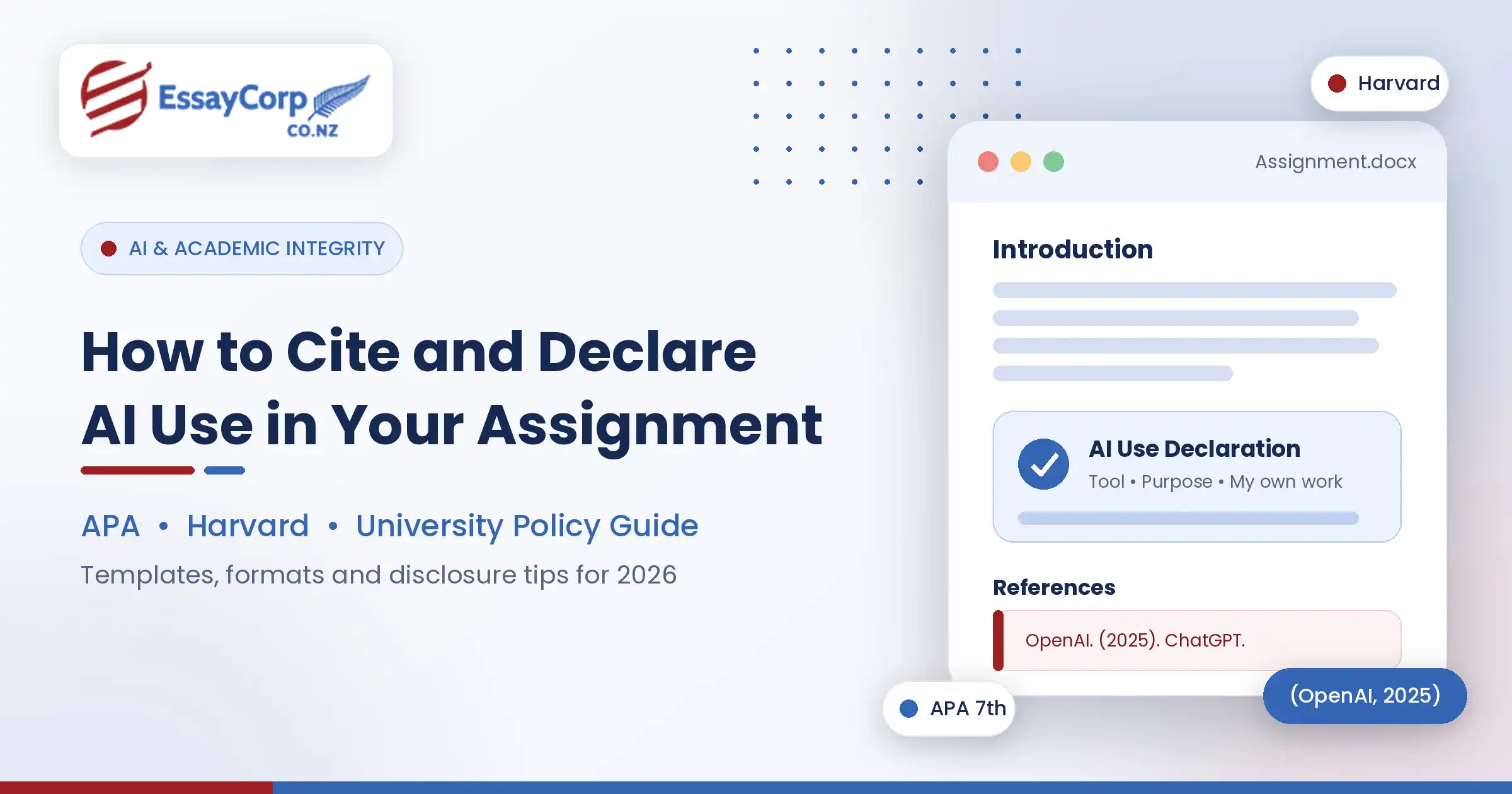
Quick answer: To cite and declare AI use correctly, start by checking what your university and your course outline allow. If AI use is permitted, add a short disclosure statement that names the tool, explains how you used it and states what you did yourself, then cite the tool in your referencing style (APA, Harvard, MLA or another) both in the text and in the reference list. If your course bans generative AI, do not use it, and if you are unsure, ask your lecturer in writing before you submit.
Generative AI tools such as ChatGPT, Gemini, Copilot and Claude have changed how students study, and they have changed how universities mark. A few years ago, the only question was whether work was copied. Today the question is also whether you were open about the tools you used. Students who are open usually stay safe. Students who say nothing, or who guess the format, are the ones who end up in academic integrity meetings.
This guide explains what to declare, how to word it and how to cite AI in the most common referencing styles. It also covers university policy types, common mistakes, how to protect yourself from false flags and how to use study support responsibly. If you study in New Zealand, Australia, the United Kingdom, the United States, Canada or anywhere else, the same principles apply, although each institution sets its own rules.
Why AI disclosure suddenly matters for students
Most academic integrity policies were written before generative AI existed. Universities have spent the last few years updating them, and the direction is fairly consistent: blanket bans are being replaced by rules about permission, disclosure and citation. Some institutions let each course decide. Others set a university-wide position and allow lecturers to be stricter.
Two things follow from that. First, the same tool can be fine in one course and prohibited in the next, even at the same university. Second, disclosure has become a basic academic skill, much like referencing a journal article. Markers now expect to see where AI helped and where it did not.
Surveys also show how common AI use has become. A 2025 report from the Higher Education Policy Institute in the United Kingdom, discussed by Turnitin, found that a large majority of students had used generative AI in their assignments. Using AI is not automatically cheating. Using it in a way your course does not allow, or hiding that you used it, is what creates risk.
There is a practical side too. When your lecturer asks how you built an argument, or an integrity officer asks how your draft developed, a clear disclosure and a record of your process are your best protection.
What counts as AI use in an assignment
Before you can declare AI use, you need to know what the term covers. Many students assume it only means copying a paragraph from a chatbot. Universities usually define it more widely.
Uses that are often permitted with disclosure
These are the uses most commonly allowed when a course permits AI at all:
- Brainstorming topic ideas or research questions
- Explaining a difficult concept in simpler language
- Generating a rough outline that you then rewrite and expand yourself
- Checking grammar, spelling and clarity in your own writing
- Suggesting search terms for finding scholarly sources
- Debugging or explaining code in a programming course, where permitted
Uses that are often restricted
These uses are frequently limited or require explicit permission from the lecturer:
- Paraphrasing or rewriting large parts of your own draft
- Summarising readings that you are meant to analyse yourself
- Generating examples, case study analysis or data interpretation
- Translating work you wrote in another language
- Producing reference lists or citations, which carry a high risk of invented sources
Uses that are usually prohibited
These are treated as academic misconduct almost everywhere:
- Submitting AI-generated text as your own work without disclosure
- Using AI in a closed-book test, exam or an assessment where AI is banned
- Inventing quotes, statistics or references produced by a chatbot
- Having someone else, or an AI tool, write the whole assignment for you to submit
If a use is not clearly covered, treat it as restricted until your lecturer confirms in writing. That single habit prevents most problems.
The three kinds of university AI policy
University policies vary in wording, but most fall into one of three groups. Knowing which group your course sits in tells you what to do next.
Policies that ban generative AI
Some courses state that any use of generative AI is a breach of academic integrity and will be treated like plagiarism. This is common in assessments that test a specific skill, such as first-year writing or a foundational coding task. In these courses, you should not use AI at all, even for brainstorming, unless your lecturer says otherwise.
Policies that allow AI with disclosure
This is the most common model today. You may use AI for specified purposes, but you must acknowledge the tool, describe how you used it and often cite it. Some universities, including large research universities in the United States, ask students to acknowledge AI use and cite it under the relevant citation guidelines, while leaving each department or lecturer to set the details.
Policies that encourage AI use
A smaller number of courses actively encourage AI, for example in data analysis, prompt design or digital media subjects. Even then, disclosure usually remains compulsory, and you remain responsible for checking the accuracy of everything the tool produces.
How to find your exact policy
Do not rely on a friend’s advice or a general web article, including this one, to decide what you are allowed to do. Check these places in order:
- The assessment brief and marking rubric for the specific assignment
- The course outline or study guide, which often has an AI statement
- The learning management system announcements for your course
- Your university’s academic integrity or student conduct page
- Your lecturer or tutor, by email, so you have a written answer
If your answer comes by email, save it. A short written confirmation of what is allowed can matter a great deal if a question comes up later.
How to write an AI disclosure statement
A disclosure statement, sometimes called an AI acknowledgement or AI use declaration, is a short note that tells the marker how AI contributed to your work. It is different from a citation, which credits a specific piece of generated content. You will often need both.
What a strong disclosure statement includes
A good statement is specific, honest and brief. It should cover:
- The name and version of the tool, for example ChatGPT or Microsoft Copilot
- The date or period when you used it
- The purpose, such as brainstorming, grammar checking or explaining a concept
- What you asked it to do, in general terms or with your actual prompts
- How you checked, edited or verified the output
- A clear statement of what you wrote and analysed yourself
Avoid vague lines such as “AI was used for assistance.” Markers cannot tell what that means, and vague statements look like an attempt to hide something.
Ready-to-use disclosure templates
Adapt the wording below to fit what you actually did. Never copy a template that describes things you did not do.
For brainstorming:
I used ChatGPT (OpenAI, version used in October 2026) to brainstorm possible research questions for this assignment. I reviewed the suggestions, chose my own topic and wrote all of the analysis and text myself. No AI-generated text appears in the submitted work.
For grammar and clarity:
I wrote this assignment myself. I used Grammarly and Microsoft Copilot to check grammar and sentence clarity after completing my draft. I reviewed each suggestion and accepted only changes that kept my meaning. The ideas, structure and analysis are my own.
For explaining a concept:
I used Gemini to explain the concept of cultural safety in simpler terms while preparing for this assignment. I then read the assigned journal articles and wrote my own explanation, referenced to those sources. I did not use AI-generated content in the final text.
For no AI use:
I confirm that I did not use generative AI tools at any stage of preparing this assignment.
That last statement is worth including when your course asks for a declaration, because a blank space can be read as an oversight.
Where to place the statement
Place it where your course tells you to. If there is no instruction, the safest options are a short note after the conclusion and before the reference list, or a labelled section such as AI Use Declaration on the title page. Keep it separate from the main body so it does not count toward your word limit unless your brief says otherwise.
How to cite AI in APA 7th edition
APA treats the output of a generative AI tool as the work of the company that created the tool. The format has been updated since APA first published guidance, so confirm the latest version on the APA Style website or in your faculty guide.
APA reference list format
The basic pattern is the developer as the author, the year of the version you used, the tool name and version in italics, a description in square brackets and the web address. For example:
OpenAI. (2025). ChatGPT (October 2026 version) [Large language model]. https://chatgpt.com
Use the year and version information that match the tool you actually used. If the tool shows a version number, include it. If it does not, use the month and year of use.
APA in-text citation
Cite the developer and year in brackets after you use or paraphrase AI-generated content, for example (OpenAI, 2025). If you name the tool in your sentence, you can write: OpenAI’s ChatGPT (2025) suggested three possible research questions, which I then refined.
Describing your prompt
APA advises that you describe the prompt you used in your text or in a note, because readers cannot retrieve a chatbot’s response the way they can retrieve a journal article. If your lecturer asks for evidence, place the full prompt and response in an appendix and refer to it in the text.
How to cite AI in Harvard referencing
Harvard is not one single style, since each university publishes its own guide, so you should always check your institution’s version first. Many guides treat generative AI as a computer program or an online source, with the developer as the author.
Harvard reference list format
A typical pattern looks like this:
OpenAI (2025) ChatGPT (October 2026 version) [Large language model]. Available at: https://chatgpt.com (Accessed: 12 October 2026).
Some Harvard guides also ask you to include the prompt in the entry or in a note, for example: Prompt: “Explain the difference between primary and secondary data.” Follow whichever format your guide shows.
Harvard in-text citation
Use the developer and year in brackets, for example (OpenAI, 2025). If your guide requires page or paragraph references for direct quotes, note that AI output has no fixed pages, so most guides advise paraphrasing rather than quoting directly.
MLA, Chicago and IEEE: quick guidance
If your course uses a different style, the principle is the same: credit the tool, name the developer and be able to show what you asked.
MLA
MLA usually treats the prompt as the title of the source and the tool as the container. The entry includes the prompt in quotation marks, the tool name, the version, the developer, the date you generated the response and the web address. MLA also asks you to cite only what you actually used, and to tell readers how you used the tool in the text.
Chicago
Chicago style typically recommends citing generated text in a footnote or endnote rather than in the bibliography, because the output cannot be retrieved by readers. The note names the tool, the prompt, the developer and the date. Check your department guide, since some lecturers still ask for a bibliography entry.
IEEE
IEEE does not have a single official format for generative AI, so engineering and computer science departments often publish their own. Where there is no guidance, treat the tool like software or an online service, give the numbered citation and add a short note describing the prompt. If your department has a template, use it exactly.
Citing versus declaring: what is the difference
Students often mix these up. The table below shows how they work together.
|
Feature |
Citation |
Disclosure statement |
|---|---|---|
|
Purpose |
Credits specific AI-generated content |
Explains how AI contributed to your process |
|
Where it appears |
In the text and the reference list |
After the conclusion or on a declaration page |
|
Length |
One line or short entry |
A short paragraph |
|
Needed when |
You use, paraphrase or quote AI output |
Your course requires an AI acknowledgement or you used AI at all |
|
Risk if missing |
Treated as uncredited source use |
Treated as undisclosed AI use |
In many courses you need both. If the course allows AI only for brainstorming and you used it only for that, a disclosure statement alone may be enough, because no AI text appears in your work. Your brief should say which applies.
Common mistakes that cost marks or trigger integrity meetings
Most integrity problems with AI come from a few repeated errors. Avoiding them is easier than recovering from them.
- Assuming a rule from one course applies to every course
- Using AI quietly because the brief did not mention it, instead of asking
- Copying an AI-generated reference list without checking that each source exists
- Citing the tool in the text but forgetting the disclosure statement, or the other way round
- Writing a vague disclosure that does not say what the tool actually did
- Using AI to paraphrase a source you have not read, which can also distort what the author said
- Treating AI output as accurate, even though it can state wrong facts with confidence
- Deleting your notes, drafts and chat history before the assignment is marked
- Leaving a template disclosure in place that does not match what you did
Invented references deserve special attention. Chatbots can produce realistic-looking citations for articles that do not exist. A fabricated reference is treated as a serious problem even when the student did not intend to deceive, because the marker cannot verify the claim. Always search for every source yourself and read it before you cite it.
AI detectors, false flags and keeping evidence of your process
Many universities run submissions through similarity and AI-writing detection tools. These tools are not perfect. Several universities have publicly said that AI detectors are unreliable and should not be used on their own to accuse a student. Detection scores can be wrong, and writing by students who use English as an additional language can sometimes be flagged unfairly.
That is why your own evidence matters more than any score. If you are ever asked to explain your work, you want to be able to show how it developed.
Evidence worth keeping
- Version history in Google Docs or Microsoft Word, which shows how your draft grew over time
- Notes, mind maps and handwritten outlines
- Saved copies of the sources you read, with your highlights
- Your search history for academic databases
- Any AI chat history, if you used a tool, along with your disclosure statement
- Emails or messages confirming what your lecturer allowed
If you are flagged
Stay calm and do not delete anything. Ask for the details of the concern in writing, read the university’s procedure and bring your evidence to the meeting. Most universities have a student advocacy service that can support you through the process. Being open and organised is far more persuasive than being defensive.
Responsible ways to use AI and human-written reference material
AI can be a useful study partner when it is used with care. It can help you understand a topic, test your explanation or suggest areas you have missed. It cannot take responsibility for accuracy, and it cannot replace reading the actual sources your course expects.
Some students also prefer reference material written and reviewed by human subject experts, because it shows how an assignment is structured, argued and referenced. A model answer works the way a past exam paper or a lecturer’s worked example does. You study it, compare it with your own draft and learn how markers expect arguments and citations to look. It should not be submitted as your own work.
How a model answer can support your learning
- It shows how an introduction, argument and conclusion fit together for your subject
- It demonstrates the correct referencing style, so you can check your own format
- It helps you see what critical analysis looks like compared with description
- It gives you something to measure your draft against before you submit
At EssayCorp, work is written by subject-qualified experts and delivered as reference and learning material, with a plagiarism and AI-check report, so you can see exactly what you are getting. You can look at real examples on our free assignment samples page before you decide anything, and read what other students say on our reviews page.
Subjects where students most often ask about AI rules
AI policy questions come up most in subjects with heavy writing or coding. If you are working in one of these areas, our subject pages explain what markers usually expect:
- Nursing assignment help for care plans, reflective practice and clinical reasoning, where accuracy and confidentiality matter
- Computer science assignment help for coding tasks where AI use is often tightly controlled
- Management assignment help and marketing assignment help for case-based reports
- Law assignment help where invented case citations are a serious risk
- Engineering assignment help where methods and standards must be shown, not just answers
AI disclosure for different types of assignment
The right level of detail depends on what you are submitting. Here is how disclosure usually works across common assessment types.
Essays and coursework
For an essay, markers care most about your argument and your reading. If you used AI for brainstorming or grammar only, a short disclosure is usually enough. If you want more guidance on structure, our essay writing help and coursework help pages cover what markers look for.
Case studies and reports
Case study analysis depends on applying a framework to a specific scenario. Many lecturers do not allow AI to generate that analysis, because it is the skill being assessed. Read the brief closely, and see our case study assignment help and report writing help pages for how these assessments are normally structured.
Dissertations, theses and research papers
Longer research projects often have stricter rules, and supervisors may require a formal AI statement in the methodology or acknowledgements. Keep a log of every AI use throughout the project. For subject-specific support, see our pages on dissertation assignment help, thesis assignment help and research paper writing help.
Coding assignments
Coding courses increasingly test whether you can explain your own code. Even where AI assistance is allowed, you may be asked to comment, test and defend your solution in person. Disclose any AI-generated snippets, understand every line and keep your commit history.
Presentations and reflective tasks
Reflective writing is meant to capture your own experience, so AI use is commonly restricted. If you used a tool to tidy wording, say so. For slide-based tasks, check whether the rule also covers AI-generated images and speaker notes.
How AI rules differ across countries and universities
There is no single global rule. Each institution decides what its students may do, and the details can change between semesters. In New Zealand, universities and other tertiary providers publish their own academic integrity and generative AI guidance, and individual courses add their own limits. The same is true in Australia, the United Kingdom, the United States and Canada.
For New Zealand students, our earlier article on whether you can use ChatGPT for a New Zealand university assignment explains how local rules are usually framed. If you are also unsure about general course support, our university assignment help page outlines how support works across levels and subjects.
International students should take extra care. If your home institution and your host institution have different expectations, follow the rules of the institution where you are enrolled. If a rule is unclear, ask your academic advisor or international student support team.
Pre-submission checklist for AI use
Run through this list before you hand in your work:
- I have read the assessment brief and the course AI policy
- I know whether AI is banned, allowed with disclosure or encouraged
- If I was unsure, I asked my lecturer and saved the reply
- I can explain every idea and every line of code in my submission
- I checked every fact, quote and statistic against a real source
- I confirmed that every reference exists and that I have read it
- My disclosure statement matches what I actually did
- My citations follow the referencing style named in my brief
- I kept my drafts, notes and version history
- I did not submit anyone else’s work, or an AI tool’s output, as my own
If you can tick every item, you are in a strong position, whichever policy your course follows.
How EssayCorp can help
EssayCorp has supported students since 2012, with subject-qualified experts across more than one hundred subjects. Our focus is on helping you understand how a strong assignment is built, not on helping you break your university’s rules. Every piece of work is written by a human expert, checked for plagiarism and AI content, and delivered as reference material for study and revision, not for direct submission.
Here is how that can fit alongside the guidance in this article:
- Use a model answer to see how your subject expects arguments, structure and referencing to look
- Ask an expert to explain a topic you are struggling with, then write your own work
- Check your referencing against a correctly formatted example in APA, Harvard, MLA, IEEE or Vancouver
- Review free sample papers before you decide whether to place an order
If you want an exact price before committing, you can get an instant quote, and you can see what a finished paper looks like in our samples library. If you would rather have one point of contact for a full brief, our managed assignment service explains how the process works, along with how to use the material responsibly.
Frequently asked questions
Q. Do I have to declare AI use in my assignment?
If your course or university requires a declaration, yes. Even where it is not mandatory, declaring is the safer choice whenever you used a generative AI tool for anything beyond a basic spell check. A short, honest statement protects you if questions come up later.
Q. How do I cite ChatGPT in APA 7th edition?
Treat OpenAI as the author, give the year of the version you used, write the tool name and version in italics, add the description Large language model in square brackets and include the web address. In the text, cite it as (OpenAI, 2025). Always check the latest APA Style guidance and your faculty’s own guide.
Q. How do I reference ChatGPT in Harvard style?
Most Harvard guides use the developer as the author, the year, the tool name and version, a description in square brackets, the URL and the date you accessed it. Because Harvard formats differ between universities, follow the exact example in your institution’s referencing guide.
Q. Is using AI for brainstorming allowed?
It depends on your course. Many universities allow brainstorming with disclosure, while some courses ban all generative AI. Check the assessment brief, and if it is not mentioned, email your lecturer to confirm before you use a tool.
Q. Do I need to include my prompts?
Often yes, or at least you need to describe them. APA and several other styles advise describing the prompt, and some lecturers ask for the full prompt and response in an appendix. When in doubt, keep your prompts saved so you can provide them if asked.
Q. What is the difference between an AI disclosure statement and a citation?
A citation credits specific AI-generated content in the text and the reference list. A disclosure statement is a short paragraph explaining how AI contributed to your process overall. Many courses ask for both.
Q. Can my university tell if I used AI?
Some universities use detection software, but these tools can be unreliable and can produce false flags, so many institutions treat them as one piece of information rather than proof. More important than detection is honesty. If your course allows AI with disclosure, declaring your use is both the right thing to do and the safest.
Q. What should I do if my work is wrongly flagged as AI-generated?
Stay calm, do not delete anything and ask for the concern in writing. Bring your drafts, version history, notes and sources to the meeting, and consider asking your student advocacy service for support. A clear record of how you developed the work is the strongest evidence you can offer.
Q. Can I use AI to write my references?
It is risky. AI tools can produce references that look real but do not exist. Always find each source yourself, read it and format the citation from the actual source details, or use a trusted referencing tool and then check the result against your style guide.
Q. Is it safe to use human-written reference material for study?
Using a model answer as a study aid is similar to using a past paper or a worked example from a lecturer, as long as you do not submit it as your own work. Use it to understand structure, argument and referencing, then write your own assignment and follow your university’s rules.
Q. Do the rules apply to international students in New Zealand and other countries?
Yes. The rules of the institution where you are enrolled apply to you, wherever you studied before. If the policies seem unclear or different from what you are used to, ask your academic advisor or student support team for written clarification.