
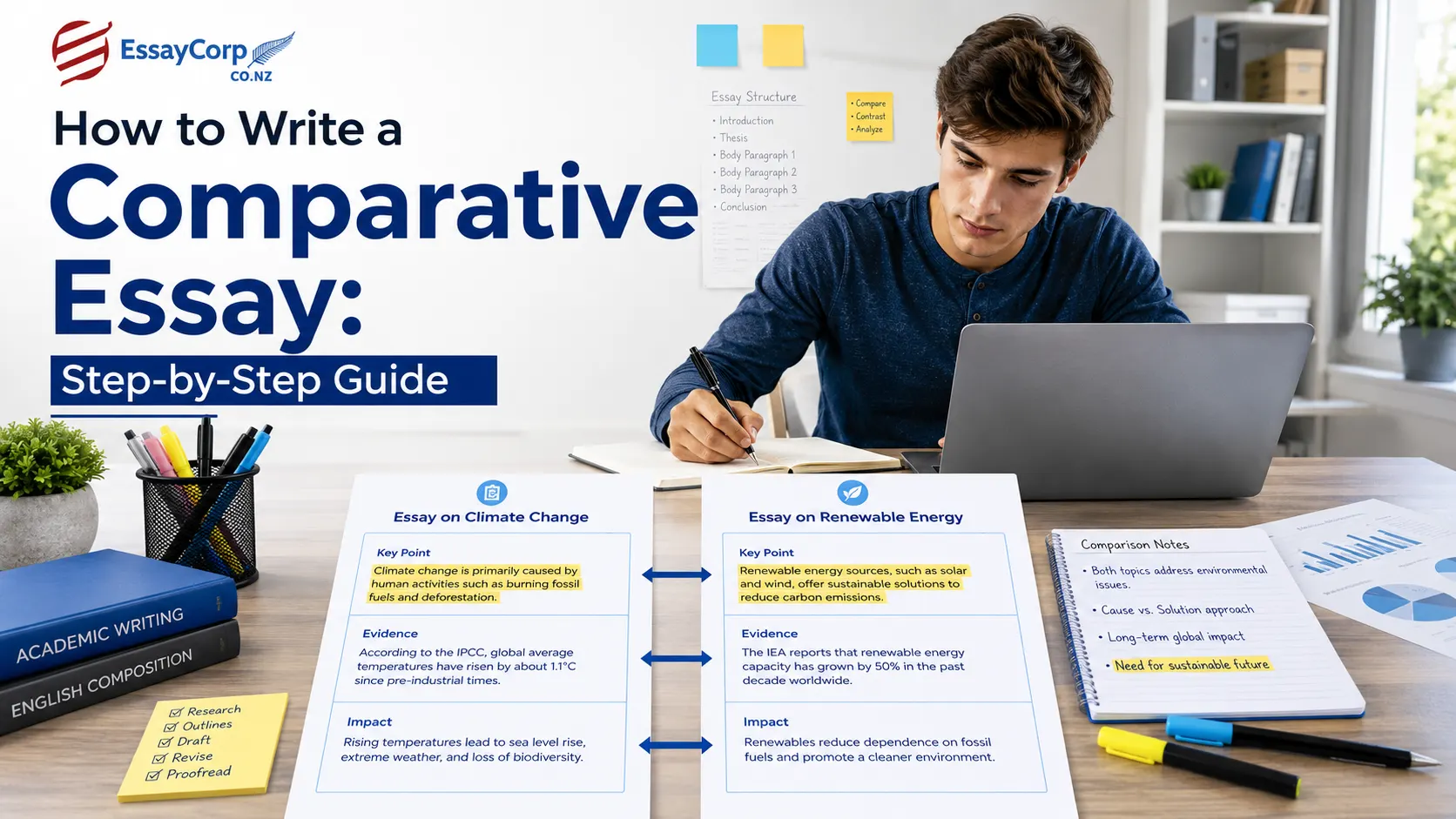
A comparative essay asks you to analyze two or more subjects side by side, highlighting what they share and where they differ. Students across New Zealand encounter this format in management, social science, nursing, and marketing courses alike. Done right, it sharpens critical thinking and shows your examiner that you can go beyond description. This guide walks you through every stage, from picking a topic to writing a tight conclusion.
What Is a Comparative Essay?
A comparative essay examines two subjects within a shared framework. You are not listing facts about each separately. You are building an argument about their relationship, showing what the comparison reveals that a single-subject essay cannot.
Common Types of Comparative Essays
- Subject-by-subject – You cover Subject A in full, then Subject B in full, then connect them in the conclusion.
- Point-by-point – You alternate between subjects for each criterion throughout the body.
- Mixed method – You open with a subject-by-subject overview, then drill into key differences point-by-point.
Most university-level assignments in New Zealand favour the point-by-point format because it keeps the comparison active throughout the paper rather than leaving all analysis to the end.
Step 1 – Choose and Narrow Your Topic
Pick two subjects that have enough in common to compare meaningfully and enough difference to make the comparison interesting. Avoid pairs that are too similar (two near-identical policies) or too distant (a nursing protocol versus a marketing strategy).
Questions to Ask Before You Begin
- Do both subjects belong to the same category?
- Can you identify at least three solid comparison points?
- Does your course material support the comparison with evidence?
If you are working on a management assignment, for example, you might compare two leadership styles such as transformational and transactional management. For a marketing assignment, two brand strategies from competing companies work well.
Step 2 – Build a Strong Thesis Statement
Your thesis is the engine of the essay. It names both subjects, signals the basis of comparison, and makes a claim.
Weak thesis: "Toyota and Tesla are both car companies with different strategies."
Strong thesis: "While Toyota prioritises incremental innovation and global supply-chain efficiency, Tesla builds competitive advantage through vertical integration and direct-to-consumer disruption, making Tesla's model more volatile but faster at capturing premium segments."
The strong version does three things: it names the subjects, establishes criteria, and takes a position. Every paragraph in the body must serve that position.
Step 3 – Create a Comparison Framework
Before writing a single sentence of the essay, draw up a simple two-column table listing your subjects at the top and your comparison criteria down the left side. This is your map.
Example Framework for a Business Communication Essay
|
Criterion |
Subject A |
Subject B |
|
Communication style |
Formal, top-down |
Collaborative, lateral |
|
Technology use |
Email-centric |
Slack and async tools |
|
Decision speed |
Slow, hierarchical |
Fast, distributed |
Students working on business communication assignment help tasks find this table especially useful because it forces you to gather evidence for both columns before you start drafting.
Step 4 – Write the Introduction
Your introduction should do four things in four to five sentences:
- Hook the reader with a relevant observation or question
- Introduce both subjects
- State the basis and purpose of comparison
- End with your thesis
Keep it tight. Examiners mark introductions quickly. A bloated opener with general background wastes words you need in the body.
Step 5 – Structure the Body Paragraphs
Point-by-Point Method (Recommended)
Each paragraph covers one criterion and addresses both subjects within it. The structure for each paragraph follows this pattern:
- Topic sentence – names the criterion and signals your argument
- Evidence for Subject A – data, quote, or case example
- Evidence for Subject B – matching evidence
- Analysis – explain what the contrast or similarity reveals
- Link sentence – connect back to the thesis or forward to the next point
Subject-by-Subject Method
Cover Subject A across all criteria in the first half of the body, then cover Subject B across the same criteria in the second half. Add a synthesis paragraph at the end that draws the comparison together. This method suits shorter essays or cases where one subject needs more context before the comparison can make sense.
Step 6 – Use Transitions That Show Comparison
Weak transitions kill comparative essays. Swap generic connectors for language that signals analysis:
Similarity transitions:
- Similarly, both... / In the same way... / Likewise...
Contrast transitions:
- In contrast... / Whereas Subject A... / Unlike... / On the other hand...
Synthesis transitions:
- Taken together... / What these differences reveal... / The deeper implication is...
Students writing social science assignment or economics assignment work often underuse synthesis transitions, leaving the reader to draw connections the writer should be making explicitly.
Step 7 – Cite Evidence Correctly
Every comparison claim needs evidence. Use primary sources, academic journals, and course-approved materials. New Zealand universities commonly require APA or Harvard referencing, so check your guidelines before you start.
Referencing Tips for Comparative Essays
- Cite both subjects with separate sources wherever possible
- Avoid citing one subject heavily and the other lightly; it signals shallow research
- Use in-text citations immediately after each claim, not at the end of the paragraph
- Cross-check your reference list against every in-text citation before submission
Students working on a dissertation assignment or thesis will find that the same citation discipline used in comparative essays applies directly to their longer research work.
Step 8 – Write the Conclusion
Your conclusion should not introduce new information. Restate your thesis in fresh language, summarise what the comparison revealed, and state the significance of your findings in one or two sentences. Four to five lines is enough.
Conclusion checklist:
- Thesis restated without copying it word-for-word ✓
- Key comparison points summarised ✓
- Broader significance or implication stated ✓
- No new arguments or evidence introduced ✓
Common Mistakes Students Make in Comparative Essays
- Writing two separate essays stitched together – Every paragraph must actively compare, not describe one subject then the other in isolation.
- Unbalanced coverage – If Subject A gets three paragraphs and Subject B gets one, the essay fails structurally.
- Vague thesis – "These two things are both similar and different" is not an argument.
- Ignoring the marking rubric – NZ university rubrics specify structure, referencing style, and word count. Treat the rubric as a checklist.
- Skipping the framework table – Students who skip the planning stage tend to discover mid-draft that their evidence doesn't match across subjects.
Students in nursing and finance courses make this last mistake most often, rushing into writing before their comparison points are fully mapped.
Quick Comparative Essay Template
Structure at a glance:
- Introduction (4–5 sentences) – hook, subject introduction, thesis
- Body Paragraph 1 – Criterion 1: Subject A vs Subject B
- Body Paragraph 2 – Criterion 2: Subject A vs Subject B
- Body Paragraph 3 – Criterion 3: Subject A vs Subject B
- Body Paragraph 4 – (Optional) Criterion 4 or synthesis of all criteria
- Conclusion (4–5 sentences) – thesis restatement, summary, significance
For a 1,500-word essay, aim for roughly 200 words per body paragraph and 150 words each for the introduction and conclusion.
When Should You Seek Assignment Help?
Writing a comparative essay demands strong analytical skills, a clear argument, and reliable evidence. If you are juggling multiple deadlines, handling coursework across subjects like engineering, computer science, or science, or simply need a model essay to understand the format better, professional case study assignment help and essay writing services can give you a well-structured reference to learn from.
Conclusion
A comparative essay succeeds when the comparison does real analytical work, not just lists facts side by side. Build your thesis before you touch the body, map your framework before you write, and keep every paragraph anchored to both subjects. Follow these steps consistently and you will produce essays that satisfy NZ university marking criteria and demonstrate genuine critical thinking.