
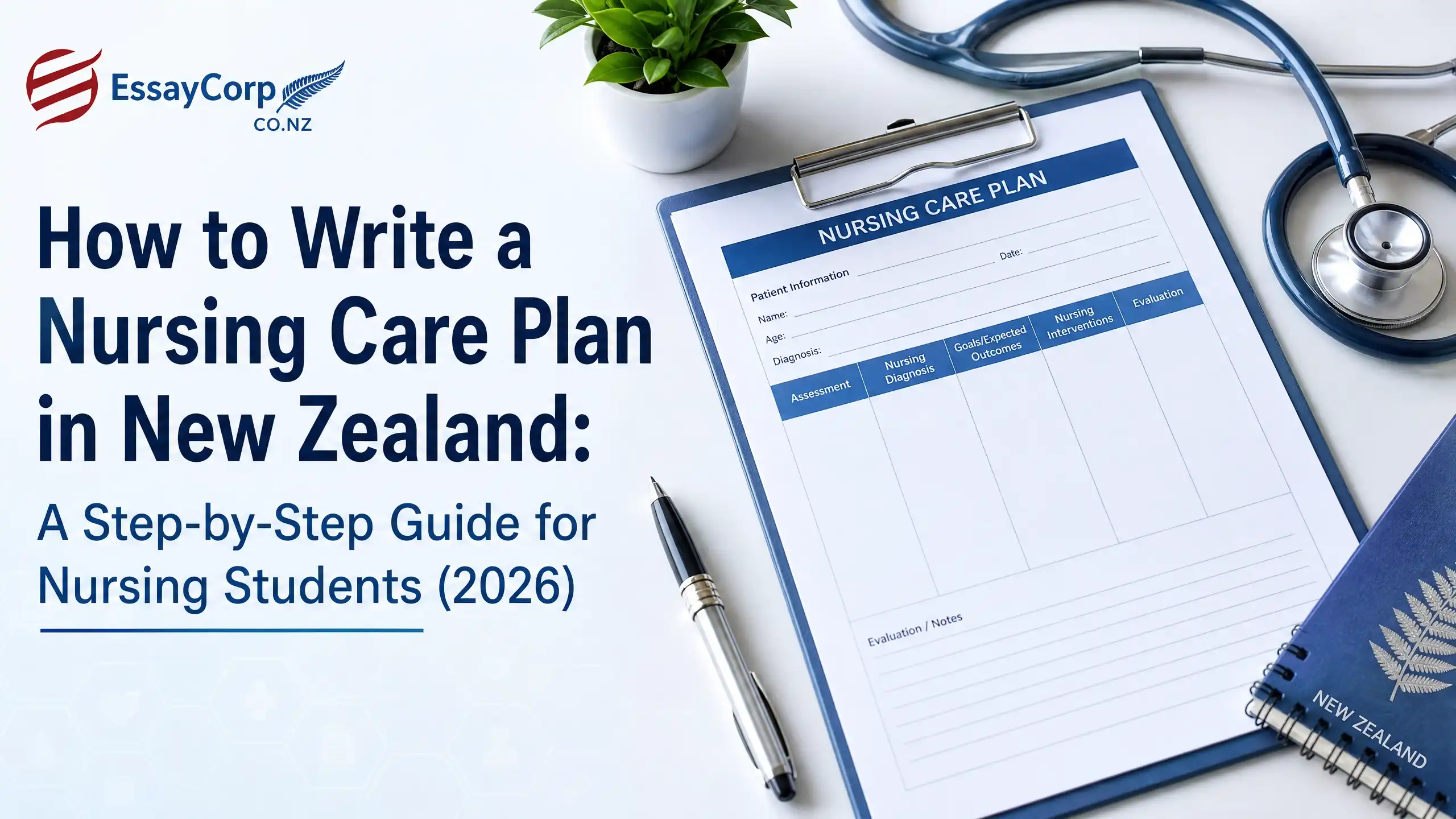
Quick Answer: A nursing care plan in New Zealand follows the nursing process — Assessment, Diagnosis, Planning, Implementation, and Evaluation (ADPIE) — and must be grounded in evidence-based practice and the New Zealand Nursing Council's competencies for registered nurses. Most NZ nursing programmes (Auckland, AUT, Otago, Massey, Waikato) also expect you to weave in cultural safety principles under Te Tiriti o Waitangi, particularly hauora M?ori models like Te Whare Tapa Wh?. A well-graded care plan is specific to one patient, uses measurable goals, and references current NZ clinical guidelines — not generic textbook statements.
If you've been handed a case study and told to "write a care plan" with no further explanation, it's easy to freeze. Lecturers assume you already know the structure, but most first- and second-year nursing students in New Zealand are seeing this format for the first time. Here's exactly how to build one that meets NZ marking rubrics.
What Is a Nursing Care Plan, and Why NZ Programmes Grade It Differently
A nursing care plan is a written, structured document that maps out a patient's health problems and the nursing actions taken to address them. In New Zealand specifically, care plans are assessed against two extra layers most international textbooks don't mention:
- Nursing Council of New Zealand (NCNZ) competencies — your plan needs to show safe, culturally competent, evidence-based practice, not just clinical accuracy.
- Cultural safety and Te Tiriti o Waitangi obligations — NZ nursing schools expect you to actively consider a patient's cultural context, not add it as an afterthought paragraph.
This is the single biggest reason international students lose marks on NZ nursing assignments: the clinical content is correct, but the plan reads like it was written for an Australian or UK audience rather than one grounded in NZ practice standards.
The ADPIE Framework: The Backbone of Every NZ Care Plan
Almost every New Zealand nursing programme structures care plans around ADPIE. Skipping a stage, or blending two together, is one of the most common reasons markers deduct points.
1. Assessment
Gather subjective and objective data about the patient. This includes vital signs, history, current symptoms, and any relevant psychosocial or cultural factors. Use a recognised framework such as the clinical reasoning cycle or a head-to-toe assessment, and be specific — "patient reports pain 7/10, localised to lower right abdomen, onset 3 hours ago" is markable; "patient is in pain" is not.
2. Diagnosis
Formulate nursing diagnoses (not medical diagnoses) using a recognised classification system such as NANDA-I. A nursing diagnosis should follow the PES format: Problem, Etiology, Symptoms — for example, "Acute pain related to surgical incision as evidenced by patient-reported pain score of 7/10 and guarding behaviour."
3. Planning
Set patient-centred goals that are SMART: Specific, Measurable, Achievable, Realistic, and Time-bound. Every intervention you plan later in the document should trace back to one of these goals — markers actively check for this alignment.
4. Implementation
List the actual nursing interventions, each with rationale drawn from current evidence — a peer-reviewed source or NZ clinical guideline, not a general nursing textbook from a decade ago. This is where most of your reference list will come from.
5. Evaluation
State how you will measure whether the goals were met, and what you'd revise if they weren't. This section is frequently rushed or left generic — a strong evaluation section explicitly ties back to the SMART goals set in step 3.
Building In Cultural Safety (Where Most International Students Lose Marks)
New Zealand nursing assessments increasingly expect explicit engagement with cultural safety, not a token sentence. Two frameworks come up constantly:
- Te Whare Tapa Wh? — the four-sided model of hauora (health): taha tinana (physical), taha hinengaro (mental/emotional), taha wh?nau (family/social), and taha wairua (spiritual). If your case study patient is M?ori, or you're asked to consider holistic care generally, this model is often expected explicitly, not just implied.
- Cultural safety vs cultural competence — NZ programmes are specific that cultural safety is defined by the patient's experience of care, not by what the nurse believes they've delivered. Framing your care plan around this distinction (rather than a generic "respect the patient's culture" line) is what separates a pass from a merit-level grade.
Common Mistakes That Cost Marks in NZ Nursing Care Plans
- Writing medical diagnoses instead of nursing diagnoses. "Appendicitis" is a medical diagnosis; "Acute pain related to inflammatory process" is a nursing diagnosis.
- Vague, unmeasurable goals. "Patient will feel better" cannot be evaluated. "Patient will report pain ≤3/10 within 4 hours of analgesia administration" can.
- Interventions with no rationale, or rationale with no citation. NZ markers want to see why an intervention works, sourced from current literature.
- Treating cultural safety as a bolt-on paragraph rather than something woven through assessment and planning.
- Using outdated or non-NZ clinical guidelines where a current New Zealand-specific standard exists (e.g., Ministry of Health or Te Whatu Ora guidance).
A Simple NZ Nursing Care Plan Structure You Can Follow
- Patient background — brief, de-identified summary of the case
- Assessment findings — subjective and objective data
- Nursing diagnosis — PES format, prioritised by urgency
- Goals — SMART, short-term and long-term
- Interventions and rationale — each tied to a goal, referenced
- Evaluation — measured against the original goals
- Cultural safety considerations — integrated, not appended
Most first-year NZ nursing care plans run 1,500–2,500 words depending on the number of nursing diagnoses required by your brief — always check your specific course outline, since word limits vary between Auckland, AUT, Otago, and Massey.
Where This Fits Into Your Wider Nursing Studies
A care plan is usually just one assessment within a broader clinical reasoning module. If you're also working through how the clinical reasoning cycle differs from the nursing process, it's worth reading both together — many NZ courses assess them side by side, and confusing the two frameworks is a common cross-assignment mistake.
If your brief covers aged care specifically, the assessment priorities shift again — falls risk, polypharmacy, and cognitive decline tend to dominate rather than acute post-surgical care, which is where our aged care nursing assignment help guidance goes into more depth.
For students who want a subject-matter expert to review a draft care plan against NZ marking rubrics before submission, our nursing assignment help team includes writers with clinical nursing backgrounds who work specifically within NZ referencing and cultural safety expectations — not generic international templates.
Frequently Asked Questions
Q. What is the ADPIE framework in nursing care plans?
ADPIE stands for Assessment, Diagnosis, Planning, Implementation, and Evaluation. It's the five-stage structure most New Zealand nursing programmes expect a care plan to follow, with each stage building directly on the one before it.
Q. What's the difference between a nursing diagnosis and a medical diagnosis?
A medical diagnosis names a disease or condition (e.g., "appendicitis"), decided by a doctor. A nursing diagnosis describes a patient's response to that condition in a format nurses can act on (e.g., "Acute pain related to inflammatory process"), usually written in PES format.
Q. How long should a nursing care plan be for NZ nursing students?
Most first-year care plans run 1,500–2,500 words, but this varies by institution and by how many nursing diagnoses your brief requires. Always check your own course outline rather than relying on a general figure.
Q. Do I need to include cultural safety in every NZ nursing care plan?
Most NZ programmes expect at least some engagement with cultural safety principles, such as Te Whare Tapa Wh?, as part of holistic assessment — not only when the patient is explicitly identified as M?ori. Check your specific rubric to see how heavily it's weighted.
Q. What referencing style is used for nursing care plans in New Zealand?
This depends on your institution — most NZ nursing schools use APA 7th edition, though some papers specify a different style. Confirm with your course outline, since submitting the wrong style can cost marks even if the content is correct.