
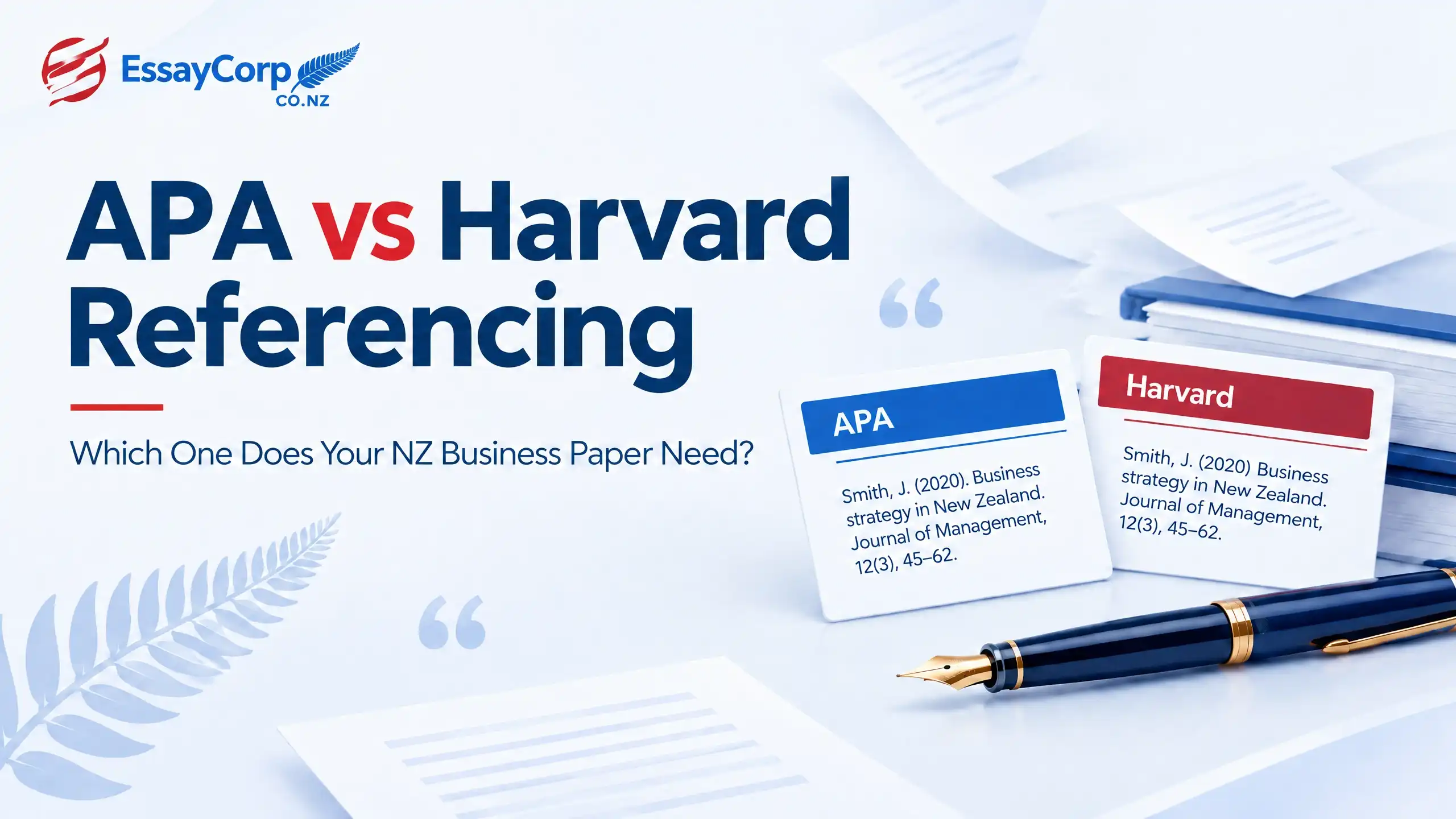
Quick Answer: Most New Zealand business schools — including Victoria Business School, Otago Business School, and Auckland Business School — default to APA 7th edition as their preferred referencing style, because it's an author-date system widely used across business, economics, and management disciplines. Harvard referencing shows up mainly in specific Management papers, some Health Science-adjacent business courses, and occasionally as an alternative in Commercial Law units. There is no single "New Zealand business referencing style" — it's set by your faculty and even your individual course guide, so the only fully reliable answer is the one printed on your assignment brief.
If you've ever opened a business assignment brief and seen "APA" or "Harvard" listed without much explanation, you're not alone. Most students assume the two styles are interchangeable — they're not. Markers in New Zealand business schools check referencing as a graded criterion, not a formality, and mixing the two styles (using APA in-text citations with a Harvard-style reference list, for example) is one of the most common, and most avoidable, ways students lose marks on an otherwise strong paper.
This guide breaks down exactly how APA and Harvard differ, which New Zealand institutions and business papers typically require which style, and how to avoid the small formatting mistakes that quietly cost marks.
Why Referencing Style Actually Matters in NZ Business Papers
New Zealand tertiary assessment tends to weigh structure and evidence far more heavily than students expect coming out of school. Most business courses publish a marking rubric before the assignment is even set, breaking marks down by criterion — structure, critical analysis, evidence, and referencing as separate, individually graded line items. That means a paper with excellent analysis but inconsistent or incorrect referencing can still lose real marks, independent of how good the argument is.
This is especially true in business papers, where you're often required to cite a mix of source types a single style guide doesn't always cover cleanly — annual reports, government data (Stats NZ, MBIE), industry reports, and peer-reviewed journal articles all need to be formatted correctly and consistently.
APA Referencing: The Default for Most NZ Business Schools
APA (American Psychological Association) style is an author-date system, now in its 7th edition. It was originally developed for psychology and social sciences but has become the standard across business, education, and health disciplines in New Zealand.
Key features of APA 7th edition:
- In-text citations use author surname and year, e.g., (Smith, 2024)
- Direct quotes require a page number, e.g., (Smith, 2024, p. 45)
- The reference list is titled "References" and alphabetised by author surname
- For three or more authors, only the first author is named, followed by "et al." from the very first citation
- When an organisation is both the author and publisher (common with government or NZ business sources like Stats NZ or MBIE), the publisher name is dropped from the reference to avoid repetition
APA is the preferred style at most business schools, including Victoria Business School, and is commonly used for Finance, Accounting, Marketing, and Management coursework across New Zealand universities. If your unit guide doesn't specify a style at all, APA is the safest default assumption for a business paper — but always confirm with your course coordinator rather than guessing.
Harvard Referencing: Where It Shows Up in Business Coursework
Harvard style is also an author-date system, structurally similar to APA, but the two are not the same — the punctuation, the way page numbers and volume/issue numbers are written, and the formatting of the reference list all differ in ways markers do check closely.
Key features of Harvard referencing:
- In-text citations also use author-date format, but punctuation conventions differ slightly from APA
- Volume and issue numbers are typically written out in full (e.g., "vol. 15, no. 2, pp. 112–128") rather than APA's condensed format (15(2), 112–128)
- There isn't one single global "Harvard style" — different universities and even different faculties publish their own Harvard referencing guide with specific rules, so if your brief says Harvard, you need to check your specific university's library guide rather than a generic Harvard template
In New Zealand, Harvard referencing appears most often in Management papers, some Health Science-related business units, and occasionally as an option alongside the New Zealand Law Style Guide in Commercial Law papers. It's also widely used across business schools in the UK and Australia, which is why some NZ courses — particularly those with international or cross-listed content — default to it.
APA vs Harvard: Side-by-Side Comparison
| Feature | APA (7th Edition) | Harvard |
|---|---|---|
| Citation logic | Author-date | Author-date |
| Common disciplines | Business, psychology, education, nursing | Management, some health/business, UK/Australia-influenced courses |
| Reference list title | "References" | Usually "Reference List" or "Bibliography" (varies by uni) |
| Volume/issue format | 15(2), 112–128 | vol. 15, no. 2, pp. 112–128 |
| Consistency across NZ | Fairly standardised by APA manual | Varies by university — always check your library's specific guide |
| Where to check | Course outline / unit guide | Course outline + your university's own Harvard guide |
Which NZ Business Schools Use Which Style?
Referencing conventions differ by faculty, and even within the same university, business papers can be treated differently from law or health papers. As a general pattern across New Zealand business schools:
- APA 7th edition is the standard for most core business papers — Finance, Accounting, Marketing, Corporate Finance, and general Management units.
- Harvard appears more selectively — often in specific Management, Human Resources, or cross-disciplinary Health-Business papers, and it's genuinely common practice across UK and Australian-influenced business programmes, which some NZ courses draw from.
- Commercial Law units sometimes allow a choice between APA and the New Zealand Law Style Guide, depending on the paper.
None of this replaces checking your actual course guide. The single most reliable source is the referencing instruction printed on your assignment brief or your university's own library referencing guide — not a general assumption about "what business schools usually do."
Common Mistakes That Cost Marks
- Mixing styles within one paper. Using APA in-text citations alongside a Harvard-formatted reference list (or vice versa) is one of the most frequent errors markers flag — pick one style and apply it consistently from your first citation to your last.
- Incorrect "et al." usage. APA 7th edition requires "et al." from the first citation for three or more authors; Harvard conventions can differ by university, so don't assume APA rules apply automatically.
- Wrong volume/issue formatting. Small punctuation differences between APA and Harvard journal citations are easy to overlook but are exactly what markers check line by line against a rubric.
- Treating "Harvard" as one universal style. Because different NZ universities publish their own Harvard guide, copying a template from a UK website can introduce formatting your lecturer doesn't expect.
- Skipping a source in the reference list. Every source cited in-text must appear in your reference list, and every entry in your reference list must have been cited in-text — inconsistencies here are an easy, avoidable mark loss.
How to Confirm the Right Style Before You Start Writing
- Check your course outline or unit guide first — this is the single most reliable source
- If it isn't specified, check your faculty's library referencing guide, since business schools usually publish their own
- When still unsure, ask your course coordinator or tutor directly rather than guessing — referencing style isn't a stylistic choice, it's a rubric requirement
- If your paper draws on a mix of journal articles, government data, and case studies, confirm early how each source type should be formatted in your required style, since business papers often cite more source types than a typical style guide covers in its basic examples
Getting referencing right is one part of a much bigger structural challenge in NZ business assignments — case-based analysis, rubric-aligned argument structure, and correctly applying frameworks to real scenarios all carry weight too. If you'd like expert guidance matched to your exact course requirements, our Management Assignment Help, Finance Assignment Help, and Accounting services are built around the applied-case standard NZ business schools actually mark against. For reflective, memo, or report-style writing tasks, our Business Communication Assignment Help page covers format expectations in more depth.
If you're also navigating how AI tools fit into your coursework, our earlier post on how AI tools like ChatGPT fit within current NZ university rules covers that in detail, and our breakdown of how much assignment help typically costs in New Zealand is a useful next read if you're weighing your options.
Frequently Asked Questions
Q. Is APA or Harvard more commonly used in New Zealand business schools?
APA 7th edition is the more common default across most NZ business schools, but Harvard is genuinely used in specific Management and cross-disciplinary papers. Your course outline is the only fully reliable source — don't assume based on general trends.
Q. Can I use APA and Harvard referencing in the same assignment?
No. Mixing citation styles within one paper is a common and easily avoidable mistake that markers specifically check for. Pick one style based on your assignment brief and apply it consistently throughout, including the reference list.
Q. What's the main difference between APA and Harvard in-text citations?
Both use an author-date format, so they look similar at a glance, but they differ in punctuation conventions and in how details like volume and issue numbers are written in full reference entries — differences that are small but consistently checked by markers.
Q. My assignment brief just says "Harvard" — which version should I follow?
Because there's no single universal Harvard style, check your specific university's library referencing guide rather than a generic online template, since formatting rules vary between institutions.
Q. What happens if I use the wrong referencing style in my NZ business assignment?
Referencing is typically a separate, graded criterion on NZ marking rubrics, so using the wrong style — or an inconsistent mix of two styles — can cost real marks even when your argument and analysis are strong.