
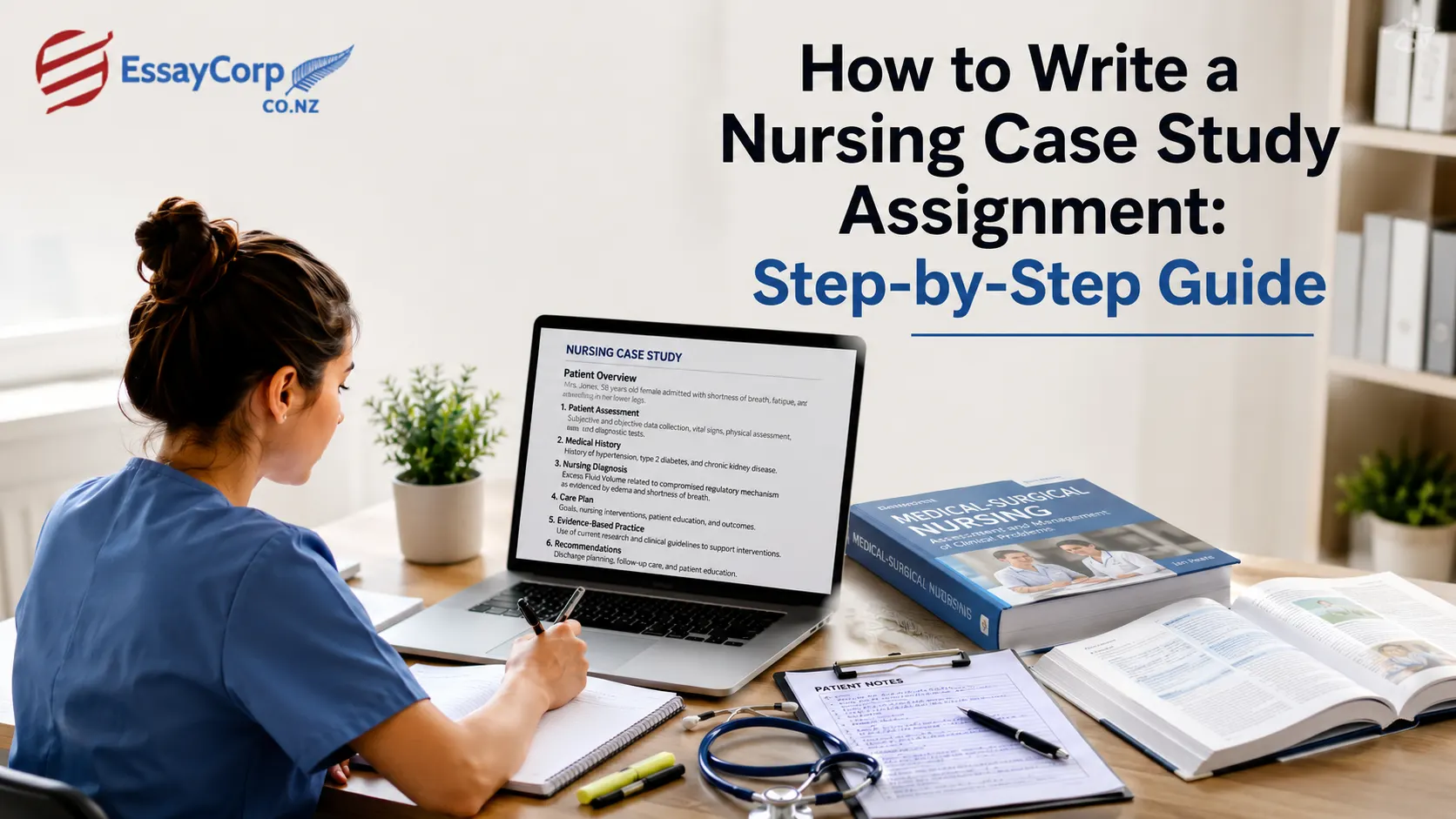
Writing a nursing case study assignment can feel overwhelming, especially when you are balancing clinical placements and multiple deadlines. This guide breaks down every stage of the process so you can approach your assignment with clarity and confidence. Whether you are a first-year nursing student or preparing for your final year, these steps apply universally across New Zealand universities.
Why Nursing Case Studies Are Important
Nursing case studies are not just academic exercises — they are designed to train you to think like a practising nurse. They test your ability to assess a patient scenario, identify clinical problems, and propose evidence-based care. Students who master this format develop stronger diagnostic reasoning, sharper communication skills, and a deeper understanding of holistic patient care. These are competencies every employer looks for in a graduate nurse.
If you find these assignments particularly challenging, our expert Nursing Assignment Help service connects you with qualified nursing professionals who understand exactly what your university expects.
Standard Structure of a Nursing Case Study
Before writing, understand the format. Most nursing case studies follow this structure:
- Title Page — Student name, ID, subject, and submission date
- Introduction — Brief overview of the patient and assignment objectives
- Patient Assessment — Clinical data, history, and presenting symptoms
- Nursing Diagnosis — Priority diagnoses using NANDA-I terminology
- Care Plan and Interventions — Evidence-based actions linked to each diagnosis
- Evaluation — Measuring whether goals were achieved
- Conclusion — Summary of key findings and clinical insights
- References — APA 7th edition citations from peer-reviewed sources
Always check your marking rubric first. Your university may require specific headings or frameworks that override this general structure.
Step-by-Step Guide to Writing Your Assignment
Step 1: Read the Case Scenario Carefully
Read the case at least twice. Highlight every clinical detail — age, gender, vital signs, diagnosis, current medications, and any red flag symptoms. Note what information is missing, as you may need to make justified assumptions in your analysis.
Step 2: Understand Your Assignment Brief
Check the marking rubric before writing a single sentence. Identify the required word count, specific questions you must answer, expected headings, and the referencing style. Many students lose marks simply by misreading the brief.
Step 3: Research the Evidence
Search CINAHL, PubMed, or the Cochrane Library for peer-reviewed literature related to your patient's condition. Focus on clinical guidelines and studies published within the last seven years. This evidence is the foundation of your entire care plan and must underpin every intervention you recommend.
Step 4: Complete a Thorough Patient Assessment
Use a structured approach such as a head-to-toe assessment or a systems-based framework. Document all subjective and objective findings from the case. Tools like ISBAR (Introduction, Situation, Background, Assessment, Recommendation) or SOAP (Subjective, Objective, Assessment, Plan) help you organise your assessment professionally.
Step 5: Identify and Prioritise Nursing Diagnoses
Select two to four priority nursing diagnoses using NANDA-I language. Always explain your prioritisation logic. Use Maslow's Hierarchy of Needs or the ABC framework (Airway, Breathing, Circulation) to justify why you have ranked one diagnosis above another. This demonstrates genuine clinical reasoning, not just a list.
Step 6: Develop Your Care Plan
For each diagnosis, write SMART goals — Specific, Measurable, Achievable, Relevant, and Time-bound. Then list your nursing interventions with a clear rationale backed by the literature you found. Include both independent nursing actions and collaborative interventions involving the broader healthcare team.
Step 7: Write, Revise, and Reference
Write in formal academic language using third-person perspective unless your rubric calls for reflection. Cite every clinical claim with a current peer-reviewed source. Proofread carefully for grammar, logical flow, and correct APA formatting. A polished final draft signals professional academic standards to your examiner.
Applying the Clinical Reasoning Cycle
Many New Zealand nursing programs require students to apply the Clinical Reasoning Cycle developed by Levett-Jones as the core framework for case study analysis. It includes eight phases:
- Consider the patient situation — establish context and patient background
- Collect cues and information — gather all clinical data from the scenario
- Process information — interpret findings and identify abnormalities
- Identify problems — formulate your nursing diagnoses
- Establish goals — set patient-centred, SMART objectives
- Take action — plan and justify evidence-based interventions
- Evaluate outcomes — assess whether goals were met
- Reflect on the process — consider what worked and what could improve
If your university uses this model, structure your assignment headings to mirror these eight phases. Doing so makes your analysis coherent and your alignment with the rubric immediately visible to your examiner.
Special Considerations for Aged Care Nursing Case Studies
Aged care scenarios introduce additional complexity — polypharmacy, cognitive decline, falls risk, and ethical questions around patient autonomy. If your case involves an elderly patient, your assignment must reflect specialised knowledge of this setting.
Key areas to address include falls risk assessment using the Morse Falls Scale, nutritional screening with the Mini Nutritional Assessment, pressure injury prevention using the Braden Scale, and advance care planning. Always discuss person-centred care principles and reference the Aged Care Quality Standards. Our Aged Care Nursing Assignment Help service is available if you need subject-specific guidance in this area.
Common Mistakes to Avoid
- Describing the case instead of analysing it — examiners want interpretation, not a retelling
- Using evidence older than seven years without strong justification
- Listing nursing diagnoses without explaining the prioritisation rationale
- Ignoring psychosocial or cultural factors in the patient assessment
- Breaching patient confidentiality by using real names — always use pseudonyms
- Submitting without proofreading for APA referencing errors
Also Read: How to Write a Comparative Essay: Step-by-Step Guide
Master the art of comparing two subjects academically with structured arguments and strong evidence — a skill that complements your nursing case study writing.
Read the Full Blog →
Conclusion
A strong nursing case study assignment requires clinical knowledge, structured analysis, and solid evidence. By following this step-by-step guide — reading your brief carefully, applying the Clinical Reasoning Cycle, prioritising diagnoses logically, and backing every intervention with current literature — you give yourself the best chance of achieving top marks. Start early, plan your sections, and revise thoroughly before submission. When the workload becomes unmanageable, expert Nursing Assignment Help is available to support you every step of the way.
Frequently Asked Questions
Q. How long should a nursing case study assignment typically be for NZ students?
Most nursing case studies range from 1,500 to 3,000 words depending on your university specific assignment brief and year of study.
Q. Which referencing style is most commonly required in nursing case study assignments?
APA 7th edition is the standard referencing format across most New Zealand nursing programs and universities.
Q. Can I use the Clinical Reasoning Cycle as a framework for every nursing case study?
Yes, it is widely accepted across New Zealand nursing programs and works effectively for structuring most case study assignments.
Q. How many nursing diagnoses should I include in a case study assignment?
Two to four prioritised diagnoses are typically sufficient, depending on the complexity of the scenario and your assignment guidelines.
Q. Is it acceptable to seek professional help with a nursing case study assignment?
Yes, accessing model answers or expert guidance from services like EssayCorp is a legitimate way to understand expectations and improve your own work.